Where next?
Travelling is undeniably one of the most widely shared passions of the 21st century.
Travelling is undeniably one of the most widely shared passions of the 21st century.
Looking Back from 2076
I can vividly imagine an ordinary high-school class in 2076. A social sciences professor—human or robotic, it is hard to predict—describes how people in our time spent their free time: travelling, flying between continents and discovering the world. What a privilege it would be to be remembered as part of the generation in which cultural barriers collapsed. No one could easily mislead us about distant places because, eventually, we could go there and see them with our own eyes. Or could we?
Well, only partially.
The Image We Leave Behind
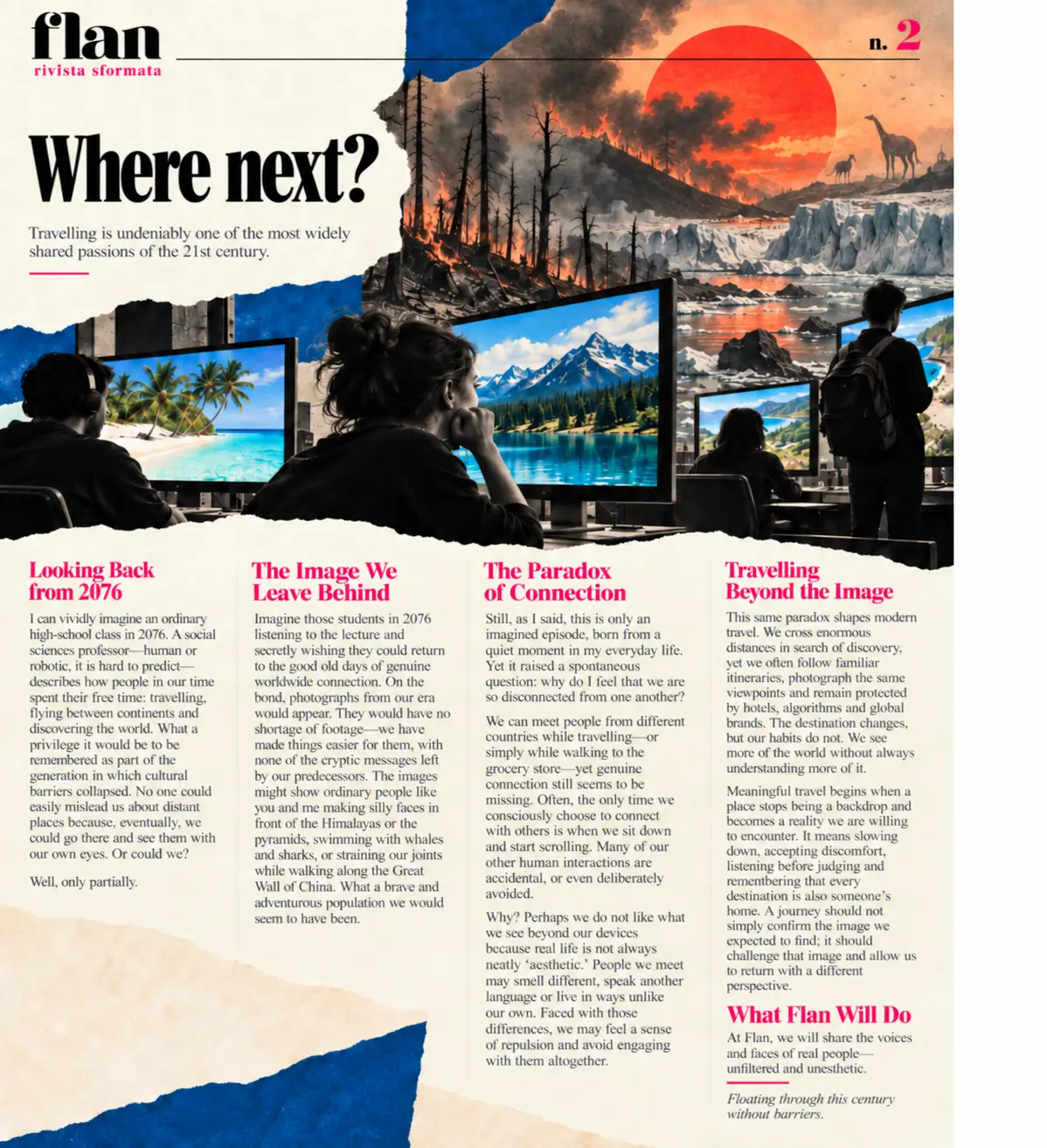
Imagine those students in 2076 listening to the lecture and secretly wishing they could return to the good old days of genuine worldwide connection. On the bond, photographs from our era would appear. They would have no shortage of footage—we have made things easier for them, with none of the cryptic messages left by our predecessors. The images might show ordinary people like you and me making silly faces in front of the Himalayas or the pyramids, swimming with whales and sharks, or straining our joints while walking along the Great Wall of China. What a brave and adventurous population we would seem to have been.
The Paradox of Connection
Still, as I said, this is only an imagined episode, born from a quiet moment in my everyday life. Yet it raised a spontaneous question: why do I feel that we are so disconnected from one another?
We can meet people from different countries while travelling—or simply while walking to the grocery store—yet genuine connection still seems to be missing. Often, the only time we consciously choose to connect with others is when we sit down and start scrolling. Many of our other human interactions are accidental, or even deliberately avoided.
Why? Perhaps we do not like what we see beyond our devices because real life is not always neatly ‘aesthetic.’ People we meet may smell different, speak another language or live in ways unlike our own. Faced with those differences, we may feel a sense of repulsion and avoid engaging with them altogether.
Travelling Beyond the Image
This same paradox shapes modern travel. We cross enormous distances in search of discovery, yet we often follow familiar itineraries, photograph the same viewpoints and remain protected by hotels, algorithms and global brands. The destination changes, but our habits do not. We see more of the world without always understanding more of it.
Meaningful travel begins when a place stops being a backdrop and becomes a reality we are willing to encounter. It means slowing down, accepting discomfort, listening before judging and remembering that every destination is also someone’s home. A journey should not simply confirm the image we expected to find; it should challenge that image and allow us to return with a different perspective.
What Flan Will Do
At Flan, we will share the voices and faces of real people—unfiltered and unesthetic.
Floating through this century without barriers.